
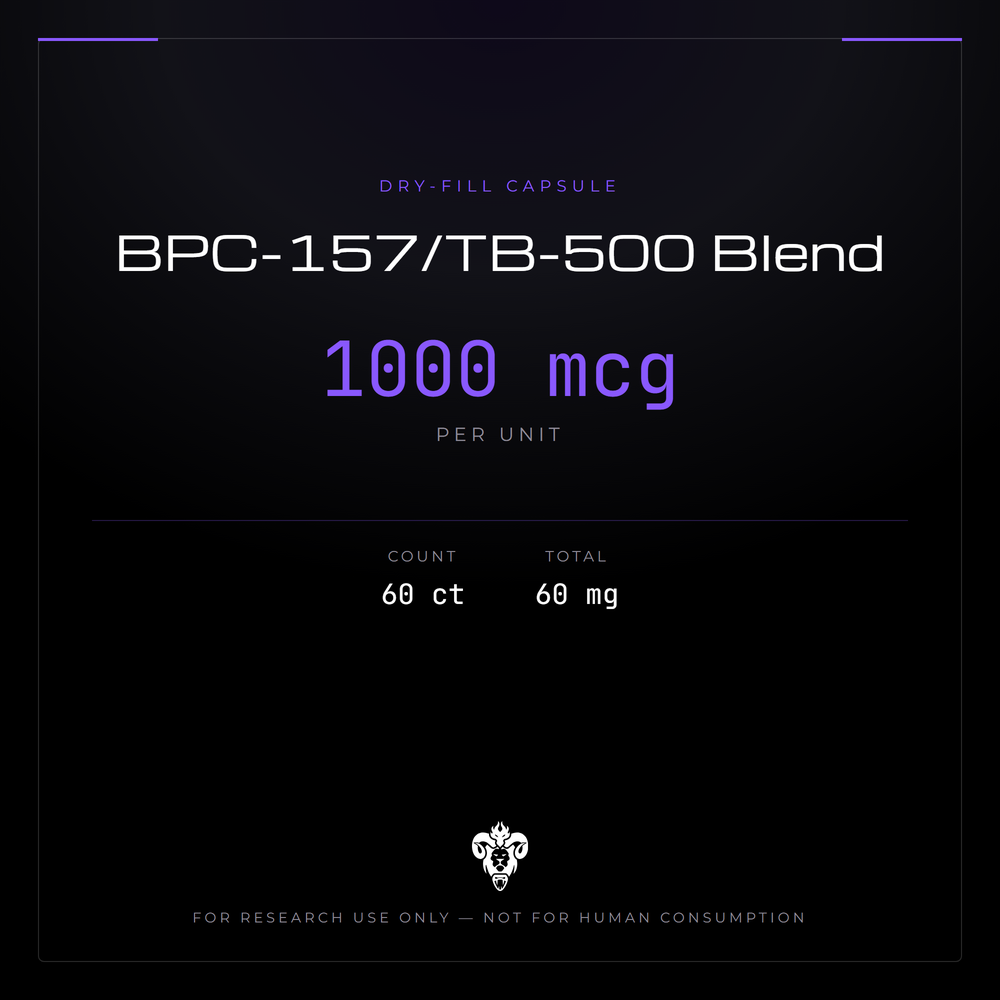

BPC-157/Thymosin Beta-4 Blend ( Dry-Fill Capsule 60ct/1000mcg/60mg) For Sale
Description
BPC-157 / Thymosin Beta-4 Research Blend
A co-formulated research material combining BPC-157 (CAS 137525-51-0), a gastric pentadecapeptide, with thymosin β-4, an actin monomer-sequestering protein. The two act by unrelated mechanisms, which is the interesting part and also the reason the combination cannot be assumed to behave like either alone.
The components
-
BPC-157 is a 15-residue partial sequence of body protection compound, isolated from human gastric juice. Its best in vitro characterisation is in tendon fibroblasts: it accelerated outgrowth from tendon explants, increased survival under H2O2 stress, and dose-dependently increased migration and spreading, with F-actin formation induced and FAK and paxillin phosphorylation raised dose-dependently while total protein was unchanged. Notably it did not directly affect fibroblast proliferation by MTT assay — the effect is on migration and survival, not cell number.[1]
-
Thymosin β-4 is an actin monomer-sequestering protein that controls cytoskeletal reorganisation.[3] Its role in migration cuts both ways: knocking it down with shRNA decreased tumour cell migration, adding it back increased migration, and it cooperates with HIF-1α to do so.[4]
What is not established
No published study tests these components in combination. Each is characterised alone, and the sections above describe them that way. There is no interaction data and no demonstration of additive or synergistic behaviour for this blend. That makes single-component control arms the difference between an interpretable experiment and an uninterpretable one.
How strong is the evidence. Worth stating plainly, because BPC-157 is described online with more confidence than its literature supports. The review above notes that the majority of studies are in small rodent models, efficacy is yet to be confirmed in humans, only a handful of research groups have worked on it in two decades, and the precise healing mechanisms remain unresolved. The in vitro fibroblast work is solid and specific; the broader claims rest on a narrow base.[2]
One component-level caveat carries into the blend. Thymosin β-4 enhances tumour cell migration cooperatively with HIF-1α.[4] That does not disappear because it is co-formulated.
Research Applications
-
Multi-analyte method development resolving the components in one sample.
-
Combination pharmacology against single-component arms — the open question.
-
Extracellular matrix and migration assays where more than one mechanism is deliberately in play.
-
Comparative profiling of blend against each constituent at matched concentration.
Analytical Documentation
Purity, identity and composition vary by manufacturing lot. Kimera Chems does not publish a single fixed purity figure for this item; refer to the batch-specific Certificate of Analysis (COA) issued for the lot received, which reflects third-party analytical testing for that lot.
Storage & Handling
Store at controlled room temperature. Keep tightly closed.
Storage guidance is a house recommendation. Analytical documentation is per-lot release testing.
| Compound Class | Peptide blend: BPC-157, TB-500 |
| CAS Number | 137525-51-0 (BPC-157) |
| Other Names | BPC-157 5mg/5mg |
| IUPAC Name | (4S)-4-[(2-aminoacetyl)amino]-5-[(2S)-2-[(2S)-2-[(2S)-2-[[2-[[(2S)-6-amino-1-[(2S)-2-[[(2S)-1-[[(2S)-3-carboxy-1-[[(2S)-3-carboxy-1-[[(2S)-1-[[2-[[(2S)-1-[[(1S)-1-carboxy-2-methylpropyl]amino]-4-methyl-1-oxopentan-2-yl]amino]-2-oxoethyl]amino]-1-oxopropan-2-yl]amino]-1-oxopropan-2-yl]amino]-1-oxopropan-2-yl]amino]-1-oxopropan-2-yl]carbamoyl]pyrrolidin-1-yl]-1-oxohexan-2-yl]amino]-2-oxoethyl]carbamoyl]pyrrolidine-1-carbonyl]pyrrolidine-1-carbonyl]pyrrolidin-1-yl]-5-oxopentanoic acid |
| Molecular Formula | C₆₂H₉₈N₁₆O₂₂ |
| Molecular Weight | 1419.5 |
| Capsule Concentration | 1000mcg x 60ct |
Be the first to review “BPC-157/Thymosin Beta-4 Blend ( Dry-Fill Capsule 60ct/1000mcg/60mg)”
Related products
Peptides For Sale

Peptides For Sale

Peptides For Sale
Peptides For Sale

Peptides For Sale
Peptides For Sale
Peptides For Sale
Peptides For Sale
Reviews
There are no reviews yet.