
GHRP-2 For Sale
Description
GHRP-2 Research Standard
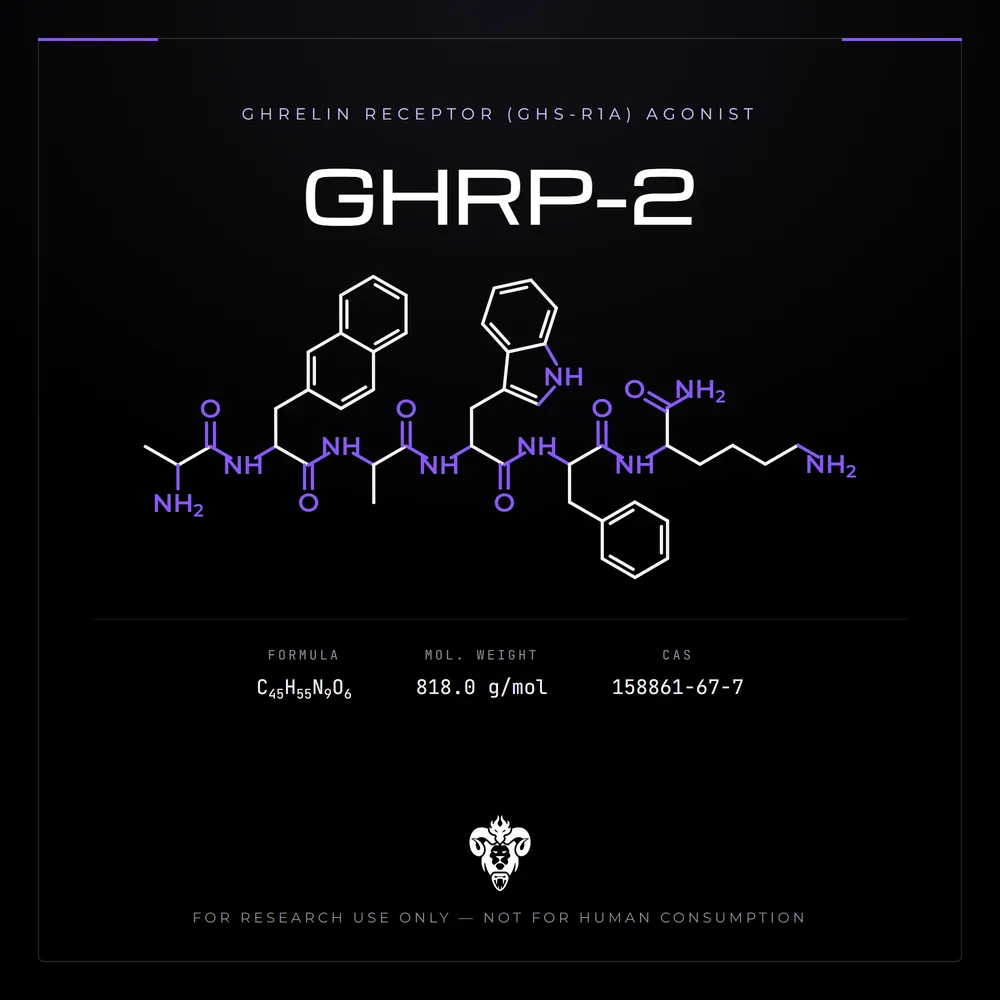
GHRP-2 is a synthetic growth hormone-releasing peptide and GHS-R1a agonist, supplied as a 5 mg lyophilized powder in a 3 mL vial. Within this class it occupies a specific and useful position: higher potency than GHRP-6 but lower maximal efficacy, which makes potency and efficacy separable in a single experiment.[1]
Mechanism of Action & Research Context
The molecular target is the growth hormone secretagogue receptor GHS-R1a, a class A G-protein-coupled receptor whose endogenous ligand is ghrelin, a peptide produced predominantly by the stomach.
-
Potency and efficacy pull apart. In conscious swine, GHRP-2 gave ED50 = 0.6 nmol/kg against GHRP-6 at 3.9 ± 1.4 — roughly sixfold more potent — while reaching a lower maximum (Emax 56 ± 6 against 74 ± 7 ng GH/mL). A compound that is more potent and less efficacious than the reference is a good tool for separating the two properties, which dose-response work often conflates.[1]
-
Raises ACTH and cortisol. Like GHRP-6 and unlike ipamorelin, GHRP-2 increased plasma ACTH and cortisol. No effect on FSH, LH, PRL or TSH was seen for any secretagogue tested.[1]
-
A shared pharmacophore. The peptidic secretagogues converge on the core Ala-Trp-(D-Phe)-Lys. Radio-competitive assay against radiolabelled ghrelin at GHSR1a has mapped which substitutions at positions 1, 2, 3 and 7 preserve or destroy binding across GHRP-1, GHRP-2, GHRP-6, hexarelin and ipamorelin — and confirmed that active metabolites, not only intact parent, retain receptor binding.[2]
-
An unusually constitutively active receptor. GHS-R1a is notable among GPCRs for high ligand-independent signalling. The interaction between the ligand-binding transmembrane domains and extracellular loop 2 appears partly responsible. That basal activity drives PLC, PKC and CRE signalling, is reversed by the inverse agonist [D-Arg1, D-Phe5, D-Trp7,9, Leu11]-substance P, and the receptor also shows C-terminal-dependent constitutive internalisation. A nonsense mutation (Ala204Glu) that alters only the constitutive activity is associated with familial short stature, which is the strongest evidence that the basal signalling matters rather than being an artefact.[3]
-
Part of the response may be indirect. Radiolabelled GHRPs accumulate in the glandular stomach, the site of ghrelin synthesis. Resecting the gastrointestinal tract attenuated the GH response to GHRP-6 by 60–70% while leaving the GHRH response intact, which points to endogenous ghrelin mediating a substantial share of the effect rather than the peptide acting on the pituitary alone.[4]
Research Applications
Primary fields of in vitro and preclinical laboratory investigation include:
-
Radio-competitive receptor binding assays against radiolabelled ghrelin at GHSR1a.[2]
-
GH release assays in primary pituitary cell culture, with GHRP and GHRH antagonists to establish which receptor is carrying the response.[1]
-
Constitutive-activity and inverse-agonist work at GHS-R1a.[3]
-
Structure-activity studies across the shared Ala-Trp-(D-Phe)-Lys core.[2]
-
Metabolite and analytical method development, where active metabolites retain receptor binding.[2]
Analytical Documentation
Purity and identity vary by manufacturing lot. Kimera Chems does not publish a single fixed purity figure for this item; refer to the batch-specific Certificate of Analysis (COA) issued for the lot received, which reflects third-party analytical testing for that lot.
Storage & Handling
Store at controlled room temperature, sealed and protected from light.
Storage guidance is a house recommendation. Analytical documentation is per-lot release testing.
| Compound Class | Synthetic hexapeptide, acetate salt |
| CAS Number | 158861-67-7 |
| Other Names | Pralmorelin, KP-102, Pralmorelin (free base), Pralmorelin [INN], E6S6E1F19M, KP-102D, KP 102, GHRP |
| IUPAC Name | (2S)-6-amino-2-[[(2R)-2-[[(2S)-2-[[(2S)-2-[[(2R)-2-[[(2R)-2-aminopropanoyl]amino]-3-naphthalen-2-ylpropanoyl]amino]propanoyl]amino]-3-(1H-indol-3-yl)propanoyl]amino]-3-phenylpropanoyl]amino]hexanamide |
| Molecular Formula | C₄₅H₅₅N₉O₆ |
| Molecular Weight | 818.0 |
Be the first to review “GHRP-2”
Related products

Secretagogue Peptides For Sale

Secretagogue Peptides For Sale
Secretagogue Peptides For Sale
Secretagogue Peptides For Sale
Secretagogue Peptides For Sale

Secretagogue Peptides For Sale

Secretagogue Peptides For Sale
Secretagogue Peptides For Sale
Reviews
There are no reviews yet.