
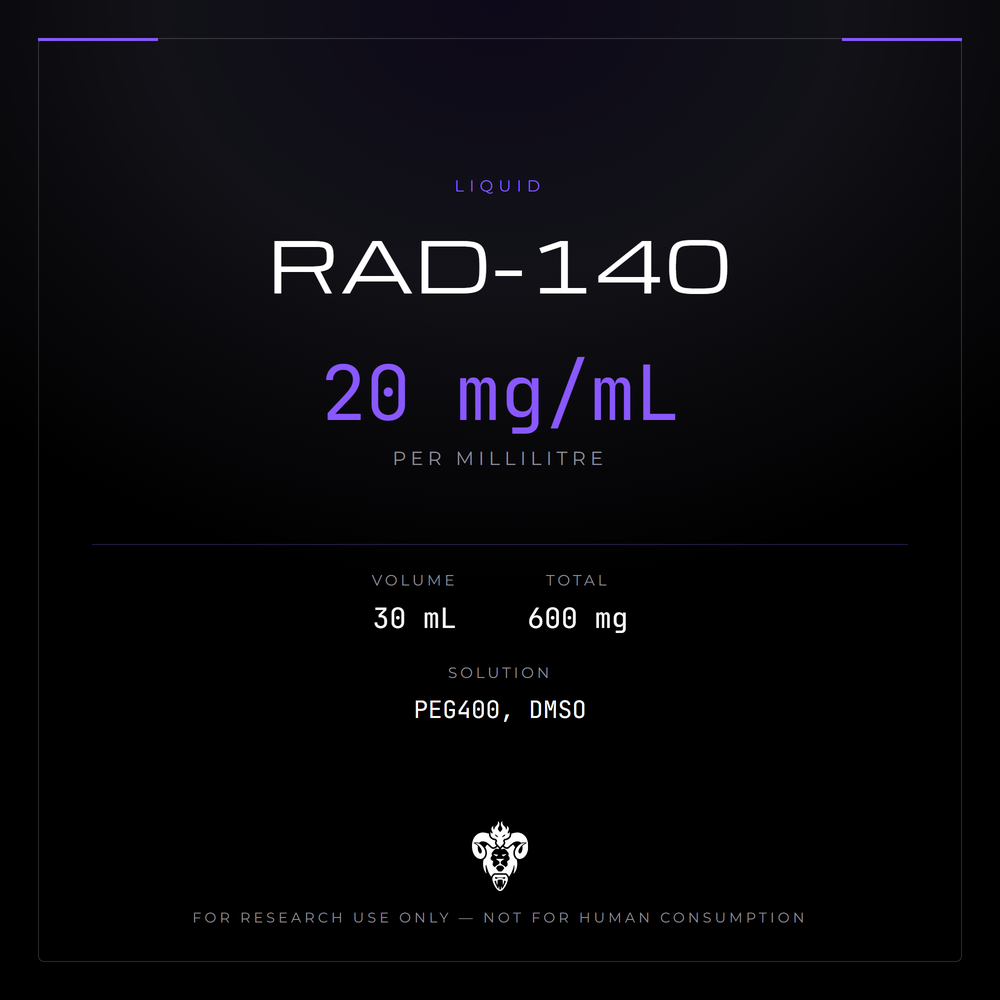
RAD-140 (Testolone) Liquid Dropper 30ml/20mg per ml/600mg For Sale
Description
RAD-140 (Vosilasarm / Testolone) Research Standard
RAD-140, also indexed as vosilasarm and testolone (CAS 1182367-47-0), is a non-steroidal selective androgen receptor modulator (SARM) built on a benzonitrile / 1,3,4-oxadiazole scaffold rather than a steroid nucleus. It is supplied as a reference standard for laboratory work on androgen receptor (AR) pharmacology, tissue-selective nuclear receptor signalling, and analytical method development. Its value as a research tool is that it activates AR in a cell-context-dependent way, which makes it a workable probe for the question the SARM class exists to ask: how one receptor produces different transcriptional outputs in different tissues.[1,2]
Mechanism of Action & Research Context
The molecular target is the androgen receptor (AR, NR3C4), a ligand-activated nuclear hormone receptor that functions as a transcription factor.
-
Receptor binding and specificity. RAD-140 binds AR with high affinity, assayed against a panel of four nuclear receptors, and its downstream transcriptional output differs by cell type — activating AR in one carcinoma cell background while failing to do so in another. That divergence in a controlled in vitro comparison is the direct experimental basis for the word “selective” in the compound class name.[2]
-
Distinct genomic and non-genomic routes. Non-steroidal SARMs and the endogenous ligand DHT engage AR through different signalling arms and assemble different AR/cofactor complexes at androgen-responsive enhancers. The two ligand types are therefore not interchangeable in mechanistic experiments, which is the point of running both.[4]
-
Coregulator recruitment and dimerisation. In the wider class literature, a SARM can drive AR transcriptional activity while producing markedly less AR homodimerisation than DHT and recruiting only a restricted subset of cofactors — with p160 coactivators SRC1, TIF2 and NCoA3 notably absent in yeast two-hybrid interaction assays. Differential coregulator recruitment is the leading mechanistic account of tissue selectivity.[5]
-
MAPK/ERK signalling. In cultured rat hippocampal neurons, RAD-140 acts through AR with signalling dependent on the MAPK/ERK pathway: ERK phosphorylation increases, and the effect is blocked by the MEK inhibitor U0126. This gives a defined non-genomic readout in a non-reproductive tissue model.[3]
Research Applications
Primary fields of in vitro and preclinical laboratory investigation include:
-
AR binding and transactivation assays. Competitive ligand-binding measurements with nuclear-receptor counter-screens, paired with AR-driven reporter assays in transfected cell lines.[1,2]
-
Coregulator and dimerisation profiling. Yeast two-hybrid and peptide-interaction panels mapping which coactivators a given ligand does and does not recruit.[4,5]
-
Signalling pathway dissection. Phospho-ERK readouts with MEK inhibition to separate genomic from non-genomic AR signalling.[3]
-
Preclinical tissue-response models. Skeletal-muscle fibre cross-sectional area and tibial microarchitecture by micro-CT, the standard rodent readouts for characterising this compound class.[6]
-
Analytical and forensic method development. Reference material for chromatographic and mass-spectrometric identification, retention-time matching and metabolite characterisation, including liver-microsome incubations for phase I profiling.
Analytical Documentation
Purity and identity vary by manufacturing lot. Kimera Chems does not publish a single fixed purity figure for this item; refer to the batch-specific Certificate of Analysis (COA) issued for the lot received, which reflects third-party analytical testing for that lot.
Storage & Handling
Store at controlled room temperature. Keep tightly closed. Liquid formats: do not refrigerate or freeze. Cold storage may cause the solution to cloud or precipitate. If this occurs, return to room temperature and mix until clear.
Storage guidance is a house recommendation. Analytical documentation is per-lot release testing.
| Compound Class | Nonsteroidal benzonitrile / 1,3,4-oxadiazole SARM |
| CAS Number | 1182367-47-0 |
| Other Names | Testolone, RAD140, RAD 140, Vosilasarm, 4O87Q44KNC, CHEMBL1672635, D09ZLZ |
| IUPAC Name | 2-chloro-4-[[(1R,2S)-1-[5-(4-cyanophenyl)-1,3,4-oxadiazol-2-yl]-2-hydroxypropyl]amino]-3-methylbenzonitrile |
| Molecular Formula | C₂₀H₁₆ClN₅O₂ |
| Molecular Weight | 393.8 |
| Capsule Concentration | 10mg x 60ct |
| Tablet Concentration | 20mg x 30ct |
| Liquid Concentration And Solution | 20mg/ml PEG400, DMSO |
| Aliquot Concentration And Solution | 50mg/ml PEG400, PEG300, Benzyl Benzoate, Benzyl Alcohol |
| Bulk Powder Quantity | 1g |
Be the first to review “RAD-140 (Testolone) Liquid Dropper 30ml/20mg per ml/600mg”
Related products
Selective Modulators For Sale

Selective Modulators For Sale

Selective Modulators For Sale
Selective Modulators For Sale
Selective Modulators For Sale

Selective Modulators For Sale

Selective Modulators For Sale
Selective Modulators For Sale
Reviews
There are no reviews yet.