
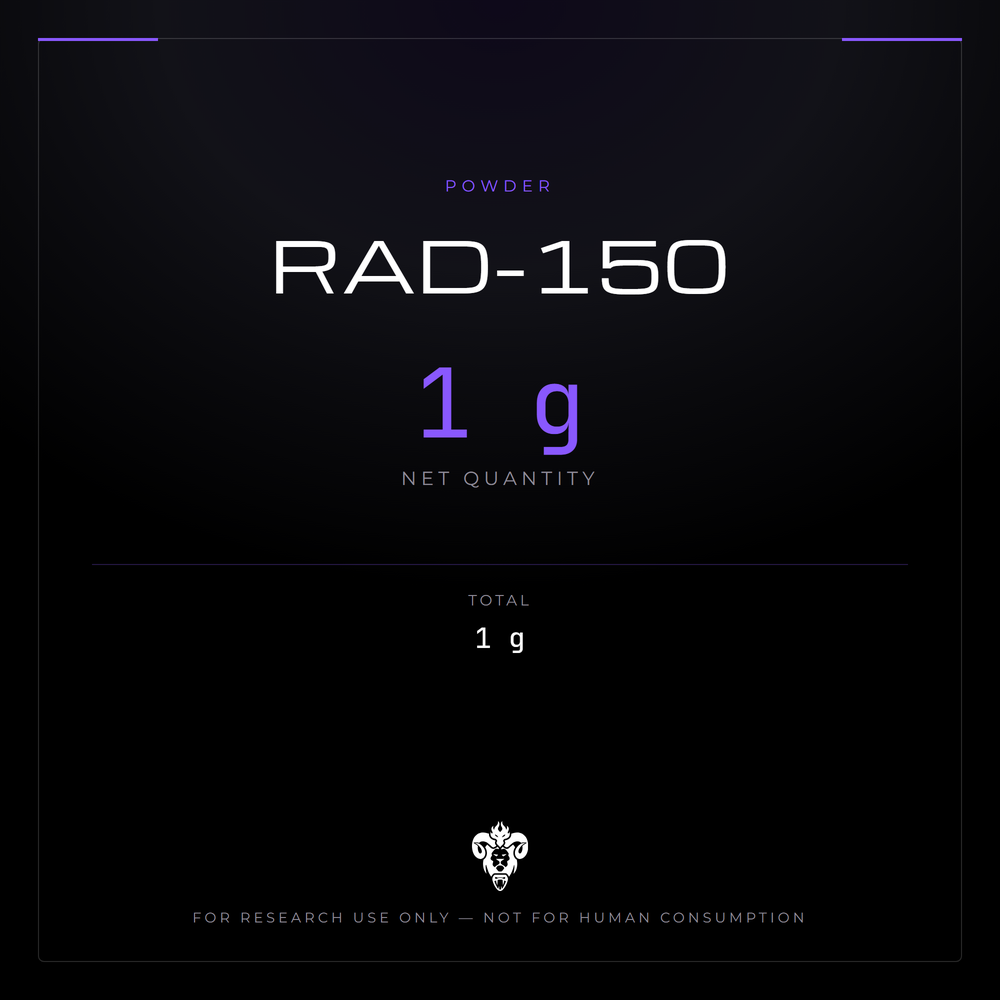

RAD-150 (TLB-150) Powder 1g For Sale
Description
RAD-150 (TLB-150) Research Material
RAD-150, also indexed as TLB-150 (CAS 1208070-53-4), is a benzoate ester derivative of RAD-140 (vosilasarm), supplied as a research material. As with other SARM esters, it is listed as a derivative of a characterised parent rather than as a characterised compound.
What is and is not known about this material
There is no published pharmacology for this ester. A PubMed search returns no studies of it: no binding affinity, no transactivation data, no pharmacokinetics, no hydrolysis kinetics, no metabolite identification. Everything below the parent-compound heading describes RAD-140, not the material on this page.
The reasoning behind an ester derivative is standard medicinal chemistry — esterifying a hydroxyl group changes lipophilicity, and the ester is expected to hydrolyse back to the parent. But expected is doing real work in that sentence. The rate and completeness of hydrolysis, whether the intact ester has activity of its own, and what fraction ever becomes parent compound are all unmeasured here. Researchers designing work around this material should establish those parameters rather than assume them, and should treat the intact ester and the parent as separate analytes when developing a method.
A note on searching for this compound: a literature search for “RAD-150” returns a small number of records from the 1970s to early 1990s. These predate RAD-140’s first publication in 2011 and are unrelated string matches, not pharmacology for this molecule.
The parent compound: RAD-140
RAD-140 is a non-steroidal selective androgen receptor modulator on a benzonitrile / 1,3,4-oxadiazole scaffold, targeting the androgen receptor (AR, NR3C4).
-
Binding and cell-context selectivity. RAD-140 binds AR with high affinity, assayed against a panel of four nuclear receptors, and its transcriptional output differs by cell type — the direct in vitro basis for the “selective” descriptor.[2]
-
Medicinal-chemistry origin. Designed and preclinically characterised as an orally bioavailable non-steroidal SARM.[1]
-
Characterised metabolism. Four phase I metabolites identified in equine liver microsomes.[3]
Research Applications
Given the absence of characterisation data, the honest applications are the ones that would generate it:
-
Ester hydrolysis kinetics in plasma, microsomes and buffer.
-
Analytical method development resolving intact ester from parent.[3]
-
Comparative receptor pharmacology of ester against parent.[1,2]
Analytical Documentation
Purity and identity vary by manufacturing lot. Kimera Chems does not publish a single fixed purity figure for this item; refer to the batch-specific Certificate of Analysis (COA) issued for the lot received, which reflects third-party analytical testing for that lot. For an ester or a multi-component blend the COA is the only document that speaks to what is actually in the vial.
Storage & Handling
Store at controlled room temperature. Keep tightly closed. Liquid formats: do not refrigerate or freeze. Cold storage may cause the solution to cloud or precipitate. If this occurs, return to room temperature and mix until clear.
Storage guidance is a house recommendation. Analytical documentation is per-lot release testing.
| Compound Class | Benzoate ester derivative of benzonitrile-oxadiazole SARM |
| CAS Number | 1208070-53-4 |
| Other Names | RAD150, RAD 150, TLB150, TLB-150, TLB 150, DTXSID40183806 |
| IUPAC Name | (1R,2S)-1-(3-chloro-4-cyano-2-methylphenylamino)-1-(5-(4-cyanophenyl)-1,3,4-oxadiazol-2-yl)propan-2-yl benzoate |
| Molecular Formula | C₂₇H₂₀ClN₅O₃ |
| Molecular Weight | 497.94 |
| Capsule Concentration | 10mg x 60ct |
| Aliquot Concentration And Solution | 50mg/ml PEG400, PEG300, Benzyl Benzoate, DMSO, Benzyl Alcohol |
| Bulk Powder Quantity | 1g |
Be the first to review “RAD-150 (TLB-150) Powder 1g”
Related products

Selective Modulators For Sale

Selective Modulators For Sale

Selective Modulators For Sale
Selective Modulators For Sale

Selective Modulators For Sale
Selective Modulators For Sale
Selective Modulators For Sale
Selective Modulators For Sale
Reviews
There are no reviews yet.