
Selank For Sale
Description
Selank Research Standard
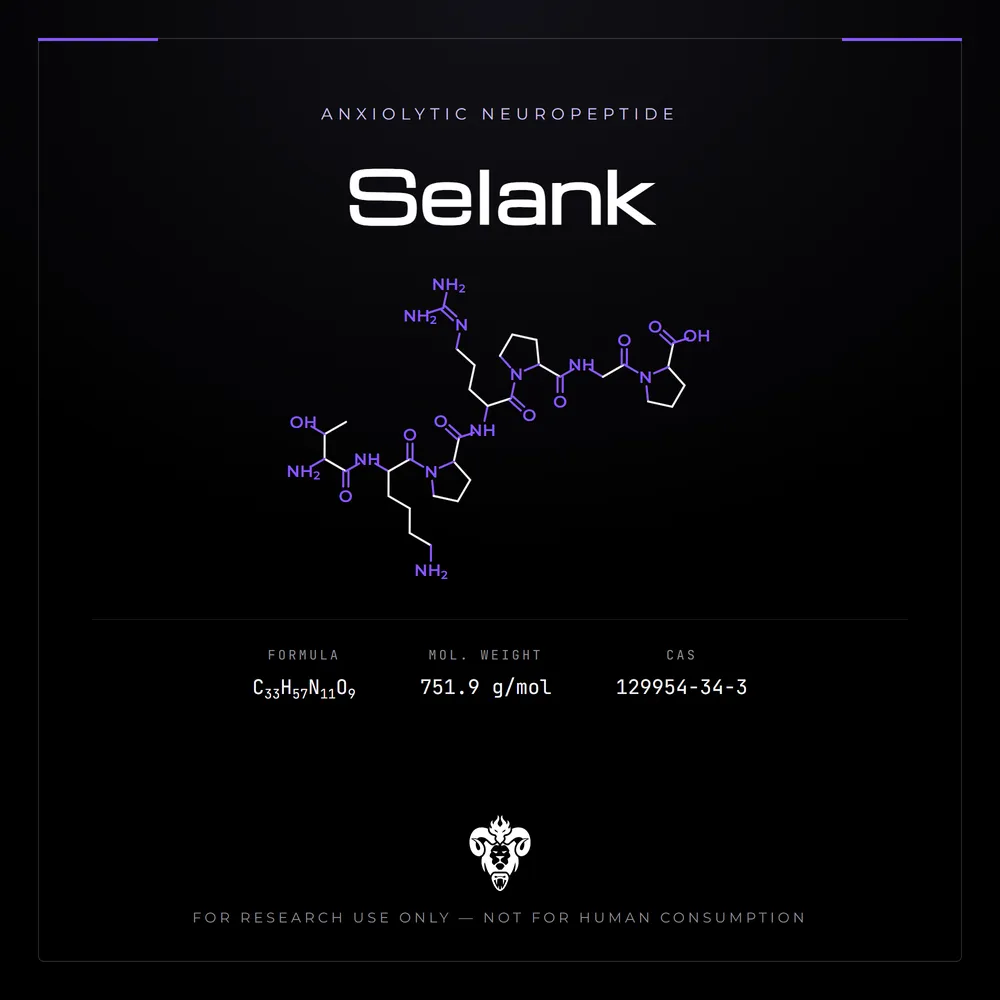
Selank (CAS 129954-34-3) is a synthetic heptapeptide built on the endogenous immunopeptide tuftsin, supplied as a 5 mg lyophilized powder in a 3 mL vial. Its published pharmacology spans two areas that are usually studied separately: neurotrophin regulation and immune gene expression.
Mechanism of Action & Research Context
Like the other peptides in this lineage, Selank has no established receptor target and its documented effects are measured as changes in expression.
-
It normalises BDNF rather than raising it. The direction matters and is easy to get backwards. In rats given 10% ethanol as their sole fluid for 30 weeks, Selank (0.3 mg/kg/day for 7 days) prevented the ethanol-induced increase in BDNF content in hippocampus and frontal cortex, while preventing memory and attention disturbances during withdrawal. It also produced a cognitive-stimulating effect in non-ethanol-exposed animals. So the compound moves BDNF toward baseline in a perturbed system rather than pushing it up unconditionally.[1]
-
Immune gene expression. A single dose significantly changed expression of chemokine, cytokine and receptor genes in mouse spleen at 6 and 24 hours.[2]
-
A two-residue pharmacophore. Most of those mRNA-level changes were reproduced by Gly-Pro alone, identified as the Selank pharmacophore and the minimum fragment carrying antiviral activity. A dipeptide accounting for the majority of a heptapeptide’s transcriptional signature is a genuinely useful structure-activity result, and a cheap control arm.[2]
-
Built from tuftsin. The parent is an endogenous immunopeptide, which is why the immune and neuro readouts sit side by side in this literature rather than in separate fields.[1,2]
Research Applications
Primary fields of laboratory investigation include:
-
BDNF quantification in hippocampus and prefrontal cortex, in perturbed and unperturbed animals.[1]
-
Chemokine and cytokine gene expression panels in spleen at multiple timepoints.[2]
-
Fragment structure-activity work comparing full peptide against Gly-Pro.[2]
-
Object recognition and attention paradigms paired with molecular endpoints.[1]
Analytical Documentation
Purity and identity vary by manufacturing lot. Kimera Chems does not publish a single fixed purity figure for this item; refer to the batch-specific Certificate of Analysis (COA) issued for the lot received, which reflects third-party analytical testing for that lot.’
Storage & Handling
Store at controlled room temperature, sealed and protected from light.
Storage guidance is a house recommendation. Analytical documentation is per-lot release testing.
| Compound Class | Synthetic heptapeptide / Tuftsin analog |
| CAS Number | 129954-34-3 |
| Other Names | Selanc, TP-7, Thr-Lys-Pro-Arg-Pro-Gly-Pro, TP 7, UNII-TS9JR8EP1G, TS9JR8EP1G |
| IUPAC Name | (2S)-1-[2-[[(2S)-1-[(2S)-2-[[(2S)-1-[(2S)-6-amino-2-[[(2S,3R)-2-amino-3-hydroxybutanoyl]amino]hexanoyl]pyrrolidine-2-carbonyl]amino]-5-(diaminomethylideneamino)pentanoyl]pyrrolidine-2-carbonyl]amino]acetyl]pyrrolidine-2-carboxylic acid |
| Molecular Formula | C₃₃H₅₇N₁₁O₉ |
| Molecular Weight | 751.9 |
Be the first to review “Selank”
Related products

Peptides For Sale
Peptides For Sale

Peptides For Sale

Peptides For Sale
Peptides For Sale
Peptides For Sale
Peptides For Sale

Peptides For Sale
Reviews
There are no reviews yet.