
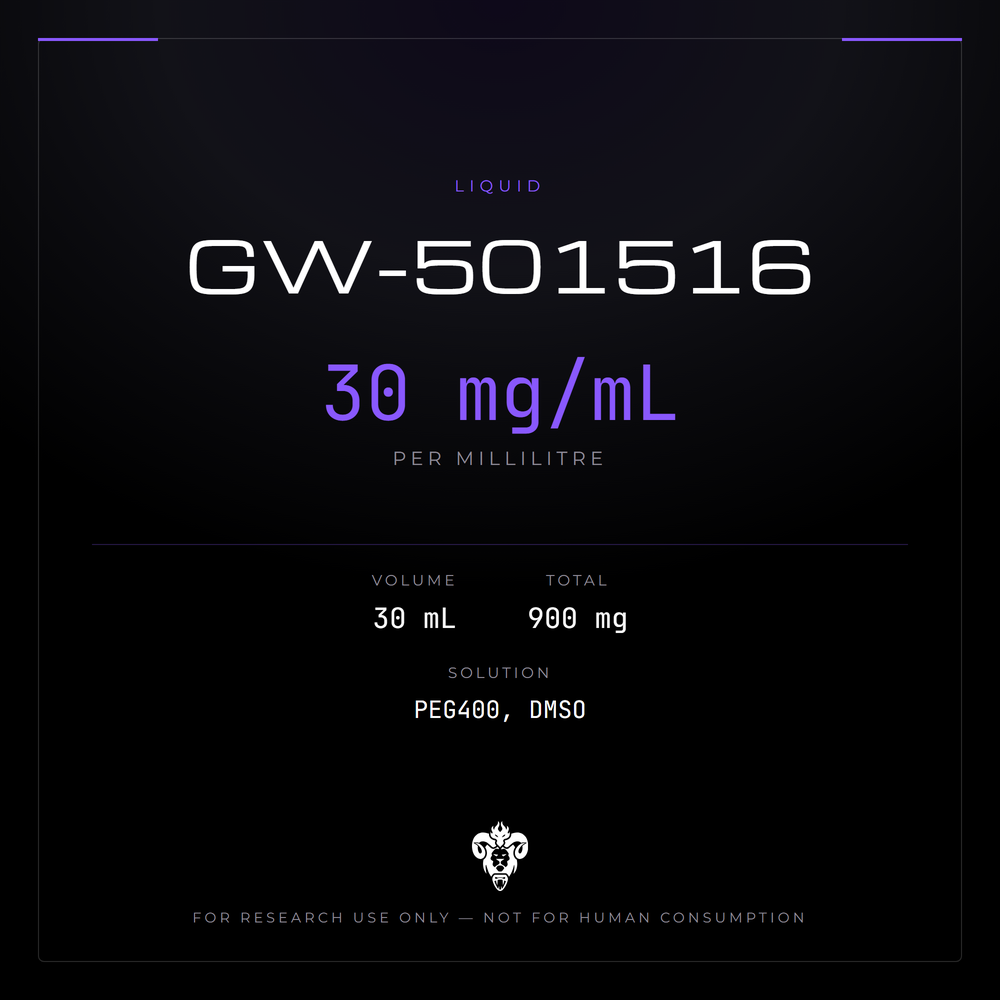


GW-501516 Liquid Dropper 30ml/30mg per ml/900mg For Sale
Description
GW-501516 Research Standard
GW-501516 (CAS 317318-70-0) is a thiazole phenoxyacetic acid derivative and a selective agonist at peroxisome proliferator-activated receptor δ (PPARδ, also written PPARβ/δ), a fatty-acid-sensing nuclear receptor abundantly expressed in skeletal muscle. It is supplied as a reference standard for laboratory work on lipid catabolism, mitochondrial gene programmes and nuclear receptor selectivity.
Mechanism of Action & Research Context
PPARδ is a ligand-activated transcription factor. Its role is most clearly separated from the other PPAR subtypes by comparing agonists side by side in the same cell background.
-
Lipid catabolism gene programme. In skeletal muscle cells, GW-501516 induces genes governing preferential lipid utilisation, β-oxidation, cholesterol efflux and energy uncoupling, and increases apolipoprotein-A1-specific efflux of intracellular cholesterol. The PPAR-dependent reporter in the muscle carnitine palmitoyltransferase-1 promoter is directly regulated by PPARβ/δ and not PPARα, in a PGC-1-dependent manner.[1]
-
Subtype division of labour. In the same system, a PPARα agonist instead induces genes for fructose uptake and glycogen formation, and a PPARγ agonist induces glucose uptake, fatty acid synthesis and lipid storage. The three subtypes drive distinct and partly opposing programmes.[1]
-
Fatty acid oxidation is not glucose handling. This distinction is where the compound is most often overstated. In L6 myotubes GW-501516 raises PGC-1α and CPT-1 expression and stimulates fatty acid oxidation, yet fails to enhance insulin sensitivity, AMPK activity, or glucose uptake and storage. The authors explicitly exclude sarcolemmal glucose transport as a target of PPARδ agonism in skeletal muscle.[2]
Research Applications
Primary fields of in vitro laboratory investigation include:
-
Nuclear receptor subtype selectivity panels comparing PPARα, β/δ and γ agonists in one cell background.[1]
-
Transcriptional profiling of β-oxidation, uncoupling and cholesterol efflux gene sets.[1]
-
Substrate-utilisation assays separating fatty acid oxidation from glucose uptake and insulin signalling.[2]
-
Promoter and reporter work on PPAR response elements such as the muscle CPT-1 promoter.[1]
-
Analytical method development for chromatographic and mass-spectrometric identification.
Analytical Documentation
Purity and identity vary by manufacturing lot. Kimera Chems does not publish a single fixed purity figure for this item; refer to the batch-specific Certificate of Analysis (COA) issued for the lot received, which reflects third-party analytical testing for that lot.
Storage & Handling
Store at controlled room temperature. Keep tightly closed. Liquid formats: do not refrigerate or freeze. Cold storage may cause the solution to cloud or precipitate. If this occurs, return to room temperature and mix until clear.
Storage guidance is a house recommendation. Analytical documentation is per-lot release testing.
| Compound Class | Thiazole phenoxyacetic acid derivative |
| CAS Number | 317318-70-0 |
| Other Names | GW501516, GW 501516, GW-501516, Cardarine, Endurobol, GSK-516, GW1516, GW 1516, UNII-7I2HA1NU22 |
| IUPAC Name | 2-[2-methyl-4-[[4-methyl-2-[4-(trifluoromethyl)phenyl]-1,3-thiazol-5-yl]methylsulfanyl]phenoxy]acetic acid |
| Molecular Formula | C₂₁H₁₈F₃NO₃S₂ |
| Molecular Weight | 453.5 |
| Capsule Concentration | 10mg x 60ct |
| Tablet Concentration | 20mg x 30ct |
| Liquid Concentration And Solution | 30mg/ml PEG400, DMSO |
| Aliquot Concentration And Solution | 50mg/ml PEG400, Propylene Glycol, Benzyl Benzoate, Benzyl Alcohol |
| Bulk Powder Quantity | 1g |
Be the first to review “GW-501516 Liquid Dropper 30ml/30mg per ml/900mg”
Related products

Nuclear Receptor Ligands For Sale
Nuclear Receptor Ligands For Sale

Nuclear Receptor Ligands For Sale
Nuclear Receptor Ligands For Sale
Nuclear Receptor Ligands For Sale
Nuclear Receptor Ligands For Sale

Nuclear Receptor Ligands For Sale
Nuclear Receptor Ligands For Sale
Reviews
There are no reviews yet.