
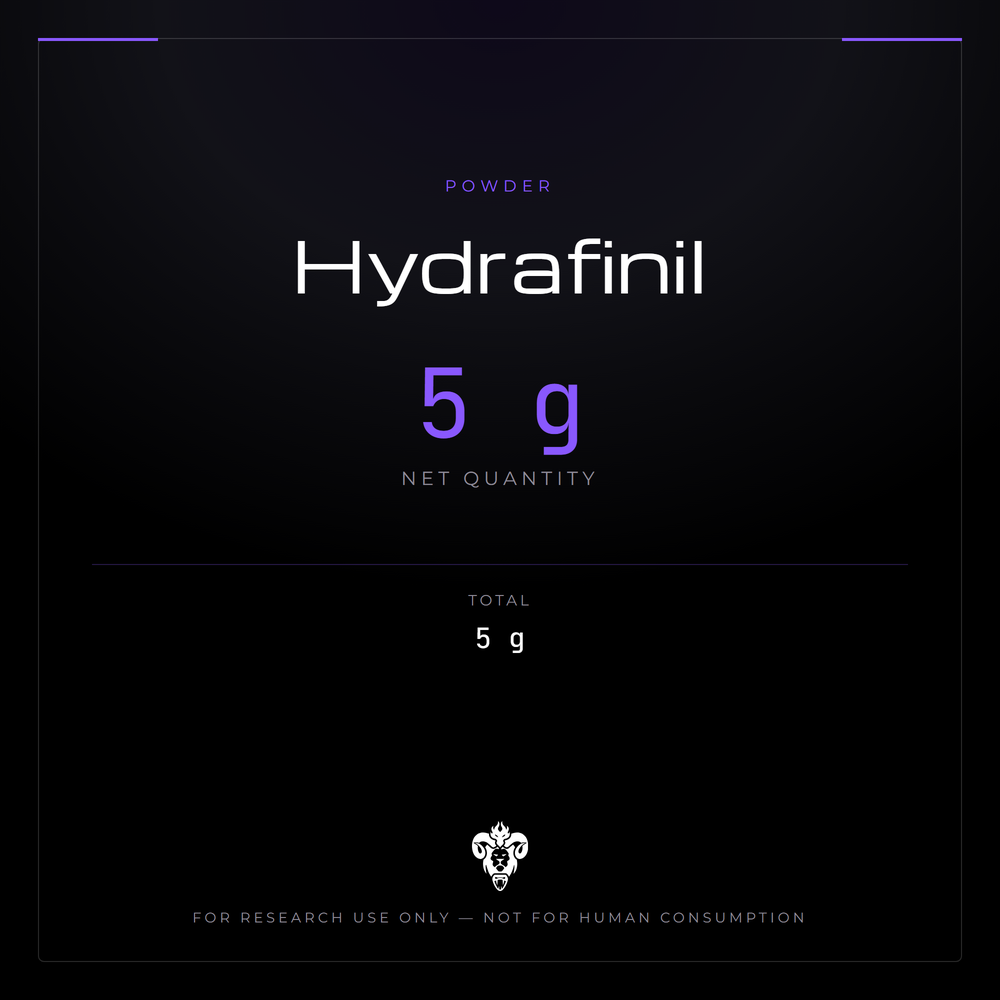


Hydrafinil (Fluorenol) Powder 5g For Sale
Description
Hydrafinil (9H-Fluoren-9-ol)
Hydrafinil is 9H-fluoren-9-ol, the secondary alcohol at the 9-position of fluorene. Fluorene itself is a tricyclic aromatic hydrocarbon in which two benzene rings are bridged by a methylene group, and the 9-position is that bridging carbon: the only sp³ centre in an otherwise flat, fully conjugated system. Hydroxylation there produces a benzylic alcohol flanked by two aryl rings, which is the structural feature that governs the compound’s chemistry.
It is worth being direct about what is and is not established. Fluorenol is a well-characterised organic compound with a long history as a synthetic intermediate and as a reference standard in polycyclic aromatic hydrocarbon analysis, where it appears as an oxidation product of fluorene. Its circulation under the name “hydrafinil” attaches it to the eugeroic literature by structural analogy to the diphenylmethane compounds, but that analogy is chemical rather than pharmacological, and the peer-reviewed record for the compound under this name is thin. It should be treated as a structural reference material, not as a characterised pharmacological tool.
Technical Specifications
| Property | Specification |
|---|---|
| Product Name | Hydrafinil (fluorenol) |
| Synonyms | 9H-fluoren-9-ol, 9-hydroxyfluorene, 9-fluorenol |
| CAS Number | 1689-64-1 |
| IUPAC Name | 9H-fluoren-9-ol |
| Molecular Formula | C₁₃H₁₀O |
| Molecular Weight | 182.22 g/mol |
| Chemical Class | Polycyclic aromatic secondary alcohol |
| Parent Hydrocarbon | Fluorene (CAS 86-73-7) |
| Appearance | White to off-white crystalline solid |
| Solubility Profile | Soluble in ethanol, methanol and DMSO; poorly soluble in water |
| Solution Base | PEG400, DMSO |
Research Applications & Chemistry
The 9-position alcohol is unusually reactive for a secondary alcohol because the carbocation formed on ionisation is the fluorenyl cation, stabilised by both flanking rings. That makes fluorenol a standard substrate in physical organic chemistry for studying solvolysis rates and carbocation stability, and it also means the compound dehydrates and oxidises more readily than an aliphatic alcohol of comparable size. Oxidation at that position gives fluorenone, which is the impurity most likely to appear on storage and the one worth resolving chromatographically.
Primary fields of laboratory investigation include:
-
PAH Metabolite Analysis: Serving as a reference standard for fluorene oxidation products in environmental and forensic chromatography.
-
Solvolysis and Carbocation Chemistry: Acting as a classical substrate for measuring benzylic ionisation rates and probing aryl stabilisation.
-
Synthetic Intermediate Work: Providing the fluorenyl scaffold for onward derivatisation, including the fluorenylmethyloxycarbonyl chemistry used in peptide synthesis.
-
Chromatographic Method Development: Resolving the alcohol from its ketone oxidation product as a system-suitability test.
-
Spectroscopic Reference: A rigid, strongly UV-absorbing scaffold useful as a fluorescence and absorbance standard.
Research Use Only Disclaimer: This product is developed and distributed strictly as a Research Use Only (RUO) laboratory reference chemical intended exclusively for non-clinical analytical and scientific investigation. It is not an FDA-approved drug, medical treatment, dietary supplement, or food ingredient, and is strictly prohibited for human or animal consumption. Kimera Chems supplies this research material solely to qualified institutions and professional investigators for authorized laboratory research.
| Compound Class | Polycyclic aromatic secondary alcohol |
| CAS Number | 1689-64-1 |
| Other Names | 9H-Fluoren-9-ol, 9-Hydroxyfluorene, 1689-64-1, 9-Fluorenol, Fluoren-9-ol |
| IUPAC Name | 9H-fluoren-9-ol |
| Molecular Formula | C₁₃H₁₀O |
| Molecular Weight | 182.22 |
| Capsule Concentration | 50mg x 60ct |
| Liquid Concentration And Solution | 75mg/ml PEG400, DMSO |
| Bulk Powder Quantity | 5g |
Be the first to review “Hydrafinil (Fluorenol) Powder 5g”
Related products
Nootropics For Sale
Nootropics For Sale

Nootropics For Sale
Nootropics For Sale
Nootropics For Sale

Nootropics For Sale

Nootropics For Sale
Hydrafinil (Fluorenol) Liquid Dropper 30ml/75mg Per ml/2.25g

Nootropics For Sale
Reviews
There are no reviews yet.