
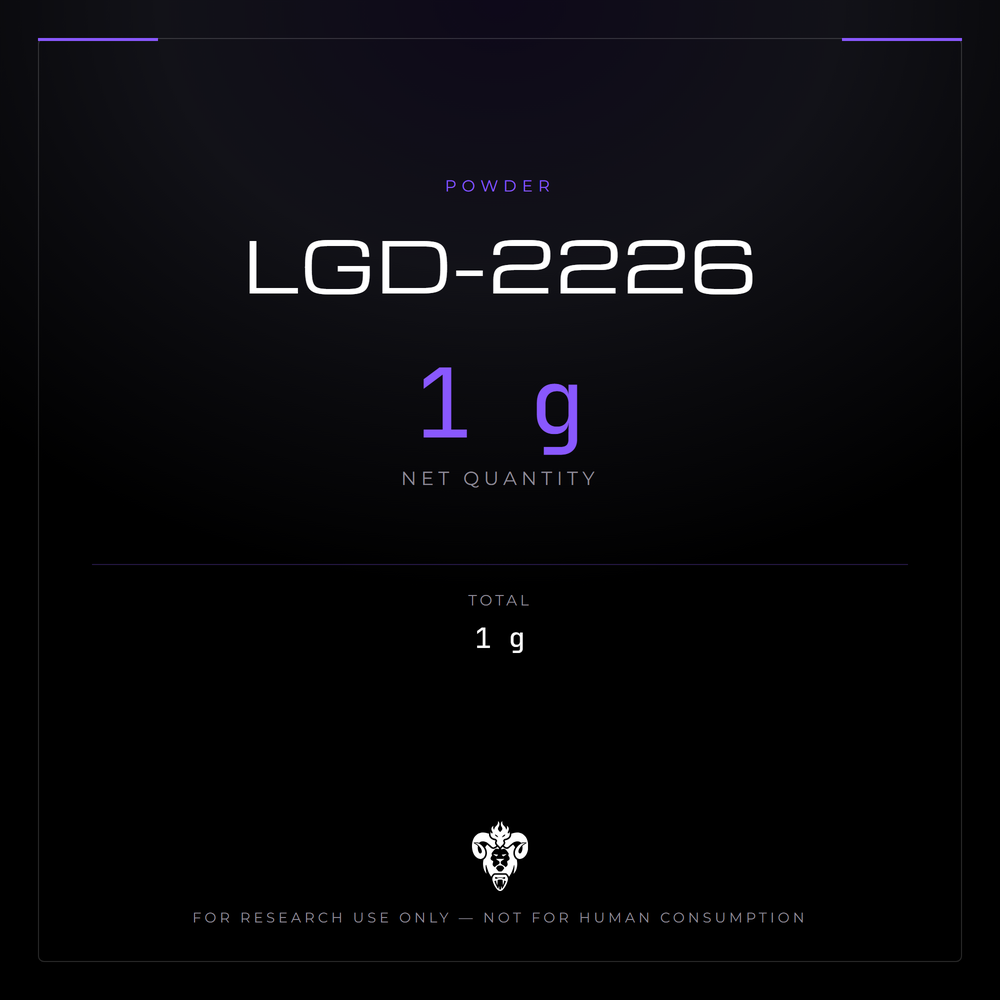


LGD-2226 Powder 1g For Sale
Description
LGD-2226 Research Standard
LGD-2226 (CAS 328947-93-9) is a nonsteroidal, nonaromatizable quinolinone-class selective androgen receptor modulator, supplied as a reference standard for androgen receptor pharmacology and analytical method development. It came out of a medicinal-chemistry programme on 6-dialkylamino-4-trifluoromethylquinolin-2(1H)-ones, and it is a useful comparator precisely because its scaffold is unrelated to both the steroid nucleus and the arylpropionamide SARMs.[1]
Mechanism of Action & Research Context
The molecular target is the androgen receptor (AR, NR3C4), a ligand-activated nuclear hormone receptor acting as a transcription factor.
-
High selectivity for AR. LGD-2226 is a highly selective AR ligand, exhibiting virtually no affinity for the other intracellular receptors — which makes it a clean tool where a steroidal androgen would engage several.[2]
-
A distinct receptor conformation. This is the mechanistically interesting part. AR bound to LGD-2226 shows a different pattern of protein-protein interactions than AR bound to testosterone or to the steroidal androgen fluoxymesterone, indicating that the ligand alters the conformation of the ligand-binding domain. Differential coregulator recruitment following that conformational change is the leading account of how one receptor produces tissue-dependent outputs.[2]
-
Nonaromatizable. It cannot be converted to an estrogenic ligand, so effects observed with it are attributable to AR engagement rather than to downstream estrogen receptor signalling — a confound that complicates work with aromatizable steroids.[2]
-
Genomic and non-genomic arms. Across the class, nonsteroidal SARMs and endogenous androgens engage AR through distinct genomic and non-genomic routes and assemble different AR/cofactor complexes at androgen-responsive enhancers.[4]
-
Cell-based activity. LGD-2226 is fully active in cell-based models of bone and muscle.[2]
Research Applications
Primary fields of in vitro and preclinical laboratory investigation include:
-
Competitive AR binding assays with nuclear receptor counter-screens.[1,2]
-
Coregulator interaction profiling comparing ligand-specific protein-protein interaction patterns against steroidal androgens.[2,4]
-
AR transactivation reporter assays in transfected cell lines.[1]
-
Structure-activity relationship work across the quinolinone scaffold.[1]
-
Analytical and forensic method development. LGD-2226 is among the SARMs covered by established chromatography-mass spectrometry screening methods, making it a standard reference analyte.[3]
Analytical Documentation
Purity and identity vary by manufacturing lot. Kimera Chems does not publish a single fixed purity figure for this item; refer to the batch-specific Certificate of Analysis (COA) issued for the lot received, which reflects third-party analytical testing for that lot.
Storage & Handling
Store at controlled room temperature. Keep tightly closed. Liquid formats: do not refrigerate or freeze. Cold storage may cause the solution to cloud or precipitate. If this occurs, return to room temperature and mix until clear.
Storage guidance is a house recommendation. Analytical documentation is per-lot release testing.
| Compound Class | Nonsteroidal tetrahydroquinolinone |
| CAS Number | 328947-93-9 |
| Other Names | LGD-2226, LGD2226, LGD 2226 |
| IUPAC Name | 6-(bis-(2,2,2-trifluoromethyl)amino)-4-trifluoromethyl-1H-quinolin-2-one |
| Molecular Formula | C₁₄H₉F₉N₂O |
| Molecular Weight | 392.225 |
| Liquid Concentration And Solution | 10mg/ml PEG400, DMSO |
| Bulk Powder Quantity | 1g |
Be the first to review “LGD-2226 Powder 1g”
Related products

Selective Modulators For Sale
Selective Modulators For Sale
Selective Modulators For Sale

Selective Modulators For Sale
Selective Modulators For Sale
Selective Modulators For Sale

Selective Modulators For Sale
Selective Modulators For Sale
Reviews
There are no reviews yet.