
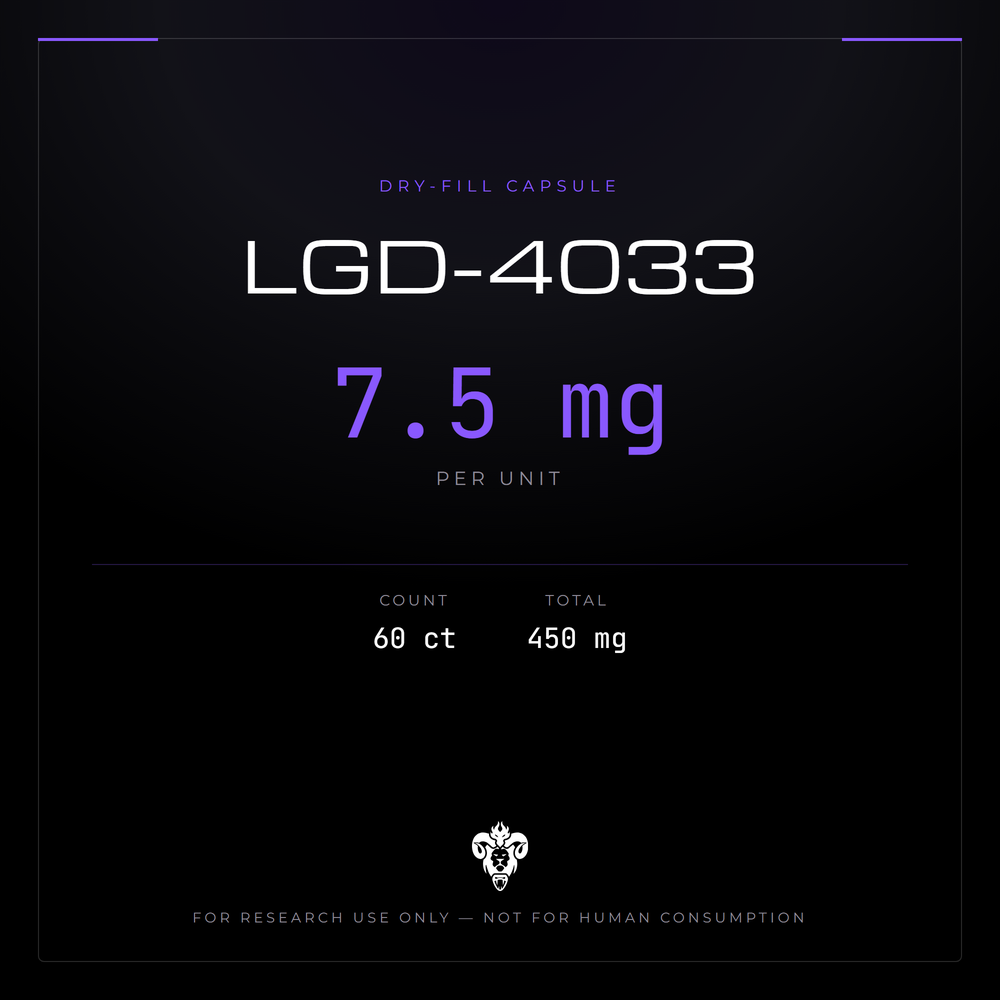
LGD-4033 (Ligandrol) Dry-Fill Capsule 60ct/7.5mg/450mg For Sale
Description
LGD-4033 (Ligandrol) Research Standard
LGD-4033, also indexed as ligandrol and VK5211 (CAS 1165910-22-4), is a nonsteroidal selective androgen receptor modulator of the pyrrolidinyl-benzonitrile structural class, supplied as a reference standard for androgen receptor pharmacology and analytical method development.[3]
Mechanism of Action & Research Context
The molecular target is the androgen receptor (AR, NR3C4), a ligand-activated nuclear hormone receptor that functions as a transcription factor.
-
Its own chemical class. The pyrrolidinyl-benzonitrile scaffold is catalogued separately from the arylpropionamides, quinolinones, indoles and phenyl-oxadiazoles in validated screening methods, so a panel intended to cover the class needs this standard specifically.[3]
-
The highest hair concentrations of the three common SARMs. Segmental hair analysis quantified ligandrol at 14–42 pg/mg against ostarine at 3–21 and andarine at 0.1–0.7 pg/mg. Hair testing detects both parent and numerous metabolites, and segmental analysis distinguishes long-term from single exposure.[1]
-
Covered by validated multi-matrix methods. Detection capability of 5 ng/mL in blood, and 0.1–1.0 ng/mL in urine screening.[2,3]
-
Distinct genomic and non-genomic routes. Nonsteroidal SARMs and endogenous androgens engage AR through different signalling arms and assemble different AR/cofactor complexes at androgen-responsive enhancers, so the two ligand types are not interchangeable in mechanistic work.[4]
-
Coregulator recruitment and dimerisation. A SARM can drive AR transcriptional activity while producing markedly less AR homodimerisation than DHT and recruiting only a restricted subset of cofactors, with p160 coactivators SRC1, TIF2 and NCoA3 notably absent in yeast two-hybrid assays. Differential coregulator recruitment is the leading mechanistic account of tissue selectivity.[5]
Research Applications
Primary fields of in vitro and preclinical laboratory investigation include:
-
AR binding and transactivation assays with nuclear-receptor counter-screens.[4,5]
-
Trace-level and segmental analysis in hair, urine and blood.[1,2,3]
-
Cross-class method validation as the pyrrolidinyl-benzonitrile representative.[3]
-
Coregulator recruitment profiling against steroidal androgens.[4,5]
Analytical Documentation
Purity and identity vary by manufacturing lot. Kimera Chems does not publish a single fixed purity figure for this item; refer to the batch-specific Certificate of Analysis (COA) issued for the lot received, which reflects third-party analytical testing for that lot.
Storage & Handling
Store at controlled room temperature. Keep tightly closed. Liquid formats: do not refrigerate or freeze. Cold storage may cause the solution to cloud or precipitate. If this occurs, return to room temperature and mix until clear.
Storage guidance is a house recommendation. Analytical documentation is per-lot release testing.
| Compound Class | Phenylpyrrolidine |
| CAS Number | 1165910-22-4 |
| Other Names | LGD4033, LGD 4033, Ligandrol, UNII-1EJT54415Am, VK-5211, 1EJT54415A, SCHEMBL221159, CHEMBL5170587 |
| IUPAC Name | 4-[(2R)-2-[(1R)-2,2,2-trifluoro-1-hydroxyethyl]pyrrolidin-1-yl]-2-(trifluoromethyl)benzonitrile |
| Molecular Formula | C₁₄H₁₂F₆N₂O |
| Molecular Weight | 338.25 |
| Capsule Concentration | 7.5mg x 60ct |
| Tablet Concentration | 15mg x 30ct |
| Liquid Concentration And Solution | 20mg/ml MCT Oil |
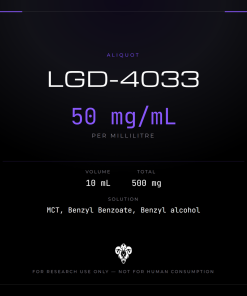
| Aliquot Concentration And Solution | 50mg/ml (MCT Oil, Benzyl Benzoate, Benzyl Alcohol) |
| Bulk Powder Quantity | 1g |
Be the first to review “LGD-4033 (Ligandrol) Dry-Fill Capsule 60ct/7.5mg/450mg”
Related products

Selective Modulators For Sale
Selective Modulators For Sale
Selective Modulators For Sale

Selective Modulators For Sale
Selective Modulators For Sale
Selective Modulators For Sale

Selective Modulators For Sale
Selective Modulators For Sale
Reviews
There are no reviews yet.