
Sermorelin For Sale
Description
Sermorelin Research Standard
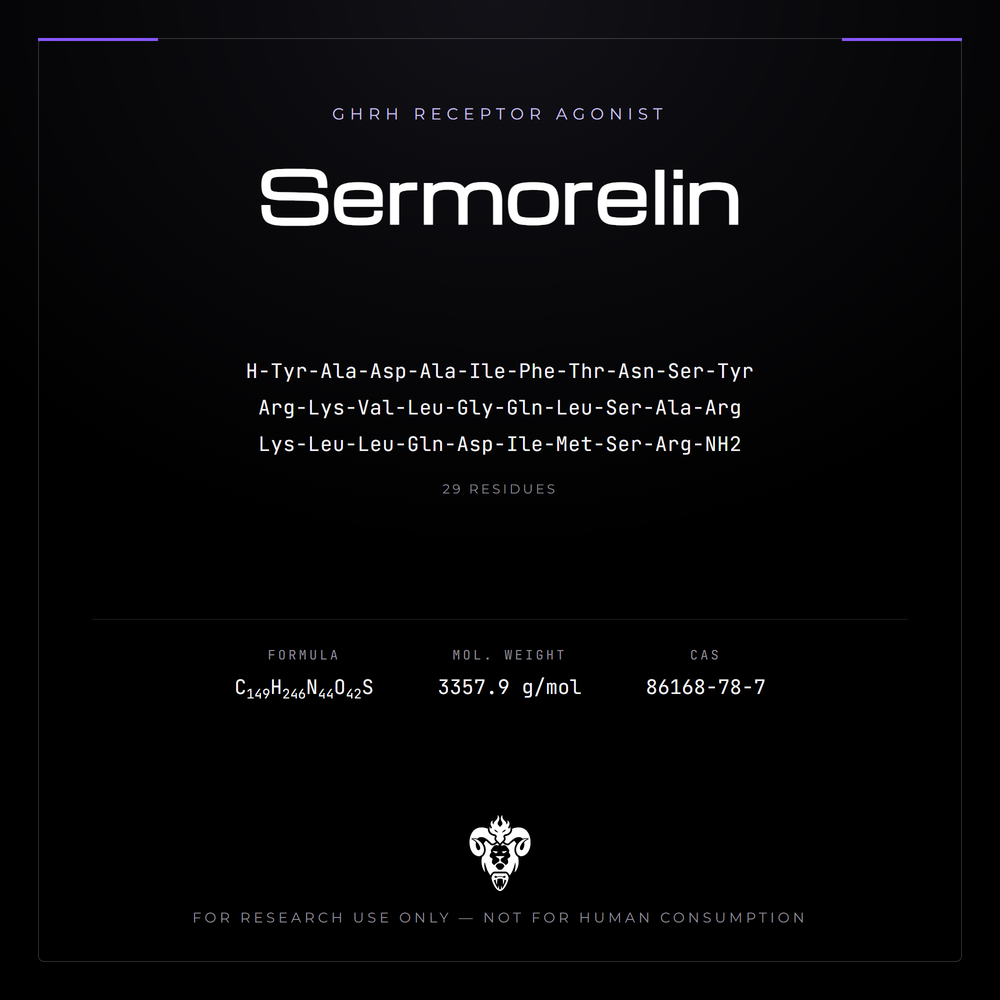
Sermorelin (CAS 86168-78-7) is GRF(1-29) amide, the N-terminal 29-residue fragment of the 44-amino-acid human growth hormone-releasing hormone and the shortest fragment retaining full activity at GHRH-R. Supplied as a 5 mg lyophilized powder in a 3 mL vial, it is the unmodified reference point against which every engineered GRF analogue in this catalogue is measured.
Mechanism of Action & Research Context
The molecular target is the growth hormone-releasing hormone receptor (GHRH-R), a class II GPCR on pituitary somatotrophs — a different receptor from the GHS-R1a targeted by the ghrelin-mimetic secretagogues.
-
The receptor. GHRH-R is a class II G-protein-coupled receptor required for normal growth hormone synthesis and release, and for normal growth and proliferation of pituitary somatotrophs. Mutations in mouse and human are associated with GH deficiency, short stature and pituitary hypoplasia. Alternative mRNA splicing produces variants proposed to act as dominant-negative inhibitors of the wild-type receptor.[1]
-
DPP-IV is the limiting factor. GRF(1-29)NH2 is degraded mainly by dipeptidyl peptidase IV, which clips the N-terminal dipeptide to leave inactive GRF(3-29)NH2. Analogues designed to resist plasma DPP-IV are markedly more stable, and that resistance carries across compartments — a DPP-IV-resistant analogue was far more stable than the parent in intestinal enterocytes as well as plasma.[2]
-
Why it is the baseline, not the endpoint. Sermorelin carries none of the protective substitutions found in the engineered analogues. It is therefore the compound that shows what unmodified GRF(1-29) does — and how quickly DPP-IV takes it apart. Any experiment claiming an analogue is “more stable” needs this arm to mean anything.[2]
-
Native methionine at position 27. Sermorelin retains Met27, reflected in its sulfur-containing formula. The engineered analogues substitute that residue, which is one reason their formulas carry no sulfur.
Research Applications
Primary fields of in vitro and preclinical laboratory investigation include:
-
GH secretion assays in cultured anterior pituitary cells as the unmodified comparator.[1]
-
Protease stability studies quantifying DPP-IV cleavage to GRF(3-29).[2]
-
Receptor pharmacology at GHRH-R, including splice-variant work.[1]
-
Analytical method development resolving parent from the GRF(3-29) metabolite.[2]
Analytical Documentation
Purity and identity vary by manufacturing lot. Kimera Chems does not publish a single fixed purity figure for this item; refer to the batch-specific Certificate of Analysis (COA) issued for the lot received, which reflects third-party analytical testing for that lot.
Storage & Handling
Store at controlled room temperature, sealed and protected from light.
Storage guidance is a house recommendation. Analytical documentation is per-lot release testing.
| Compound Class | Synthetic GHRH analog peptide |
| CAS Number | 86168-78-7 |
| Other Names | Sermorelina, Somatoliberin, UNII-89243S03TE, SCHEMBL34139, DTXSID70903978 |
| IUPAC Name | (3S)-4-[[(2S)-1-[[(2S,3S)-1-[[(2S)-1-[[(2S,3R)-1-[[(2S)-4-amino-1-[[(2S)-1-[[(2S)-1-[[(2S)-1-[[(2S)-6-amino-1-[[(2S)-1-[[(2S)-1-[[2-[[(2S)-5-amino-1-[[(2S)-1-[[(2S)-1-[[(2S)-1-[[(2S)-1-[[(2S)-6-amino-1-[[(2S)-1-[[(2S)-1-[[(2S)-5-amino-1-[[(2S)-1-[[(2S,3S)-1-[[(2S)-1-[[(2S)-1-[[(2S)-1-amino-5-carbamimidamido-1-oxopentan-2-yl]amino]-3-hydroxy-1-oxopropan-2-yl]amino]-4-methylsulfanyl-1-oxobutan-2-yl]amino]-3-methyl-1-oxopentan-2-yl]amino]-3-carboxy-1-oxopropan-2-yl]amino]-1,5-dioxopentan-2-yl]amino]-4-methyl-1-oxopentan-2-yl]amino]-4-methyl-1-oxopentan-2-yl]amino]-1-oxohexan-2-yl]amino]-5-carbamimidamido-1-oxopentan-2-yl]amino]-1-oxopropan-2-yl]amino]-3-hydroxy-1-oxopropan-2-yl]amino]-4-methyl-1-oxopentan-2-yl]amino]-1,5-dioxopentan-2-yl]amino]-2-oxoethyl]amino]-4-methyl-1-oxopentan-2-yl]amino]-3-methyl-1-oxobutan-2-yl]amino]-1-oxohexan-2-yl]amino]-5-carbamimidamido-1-oxopentan-2-yl]amino]-3-(4-hydroxyphenyl)-1-oxopropan-2-yl]amino]-3-hydroxy-1-oxopropan-2-yl]amino]-1,4-dioxobutan-2-yl]amino]-3-hydroxy-1-oxobutan-2-yl]amino]-1-oxo-3-phenylpropan-2-yl]amino]-3-methyl-1-oxopentan-2-yl]amino]-1-oxopropan-2-yl]amino]-3-[[(2S)-2-[[(2S)-2-amino-3-(4-hydroxyphenyl)propanoyl]amino]propanoyl]amino]-4-oxobutanoic acid |
| Molecular Formula | C₁₄₉H₂₄₆N₄₄O₄₂S |
| Molecular Weight | 3357.9 |
Be the first to review “Sermorelin”
Related products

Secretagogue Peptides For Sale
Secretagogue Peptides For Sale

Secretagogue Peptides For Sale
Secretagogue Peptides For Sale
Secretagogue Peptides For Sale
Secretagogue Peptides For Sale

Secretagogue Peptides For Sale

Secretagogue Peptides For Sale
Reviews
There are no reviews yet.