
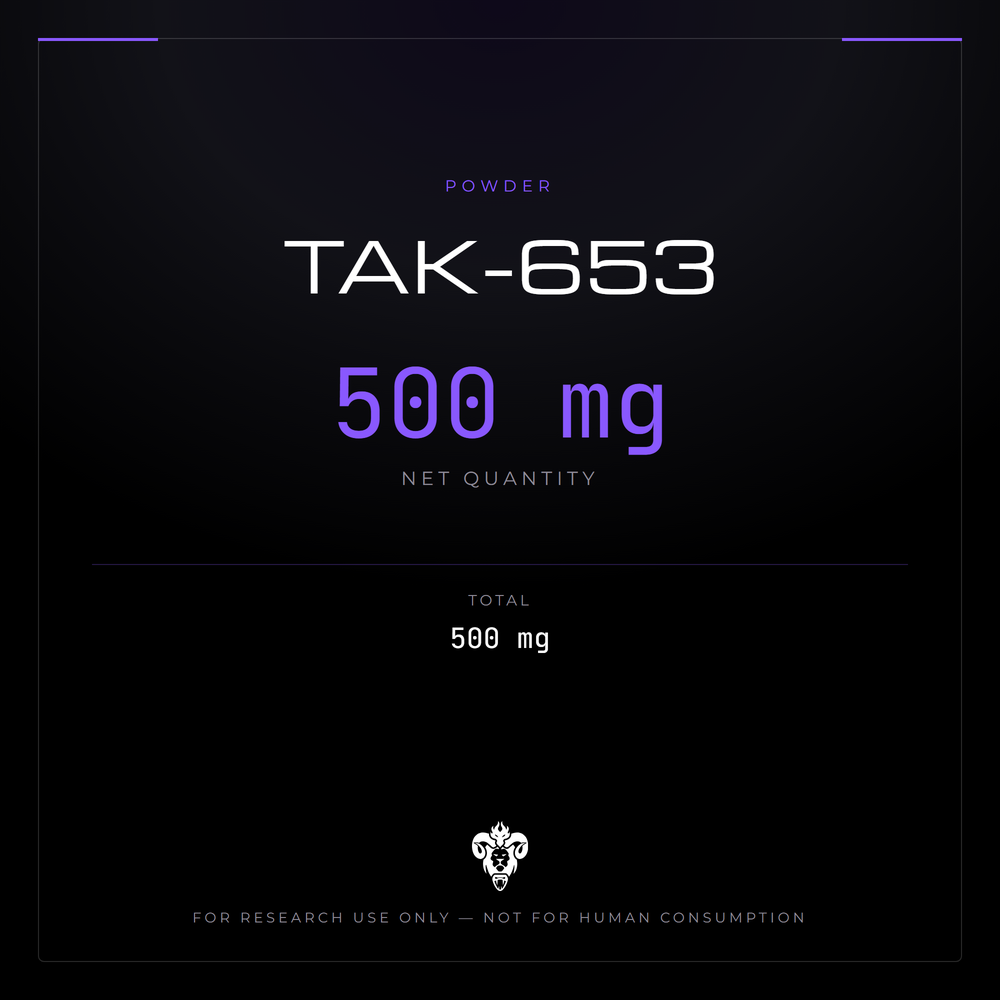
TAK-653 Powder 500mg For Sale
Description
TAK-653 (Osavampator) Research Standard
TAK-653 (Osavampator / NBI-1065845) is a synthetic pyrazinothiadiazine dioxide that functions as a positive allosteric modulator (PAM) of the AMPA-type glutamate receptor. By design, TAK-653 serves as a “glutamate-dependent” potentiator; it stabilizes the active conformation of the AMPA receptor specifically in the presence of endogenous glutamate, with minimal intrinsic agonist activity. This specific gating mechanism provides a distinct safety margin compared to earlier high-efficacy AMPA PAMs, which were historically associated with convulsive liability. In laboratory research, TAK-653 is a vital tool for studying the intricacies of AMPA receptor electrophysiology and the modulation of glutamatergic neurotransmission.
Technical Specifications
| Property | Specification |
|---|---|
| Product Name | TAK-653 (Osavampator) |
| IUPAC Name | 9-[4-(cyclohexyloxy)phenyl]-7-methyl-3,4-dihydropyrazino[2,1-c][1,2,4]thiadiazine 2,2-dioxide |
| CAS Number | 1358751-06-0 |
| Chemical Formula | C19H23N3O3S |
| Molecular Weight | 373.47 g/mol |
| Chemical Class | Pyrazino-thiadiazine 2,2-dioxide |
| Potency | EC50 ≈ 3.3 µM (glutamate-evoked Ca2+ influx) |
| Solubility | DMSO (~75 mg/mL); Insoluble in water/ethanol |
| Assay Purity | Refer to the batch-specific Certificate of Analysis (COA) supplied for the lot received |
| Solution Base | PEG400, DMSO |
Mechanism of Action & Research Context
TAK-653 differentiates itself from first-generation AMPA potentiators through its unique interaction with the glutamate-binding pathway.
-
Glutamate-Dependent Gating: The compound potentiates receptor currents only when endogenous glutamate is already bound to the receptor. This minimizes the risk of receptor over-activation (excitotoxicity) that plagued earlier, less-selective PAMs.
-
Structural Interaction: Molecular modeling localizes the activity of TAK-653 to the Ser743 residue within the GluA1 subunit of the AMPA receptor.
-
Minimal Intrinsic Agonism: Because it acts as a strictly agonist-dependent potentiator, it offers a refined chemical probe for investigating the physiological tuning of excitatory synapses without confounding seizure-related variables.
Research Applications
TAK-653 is an essential reagent for investigating the dynamics of the central nervous system’s excitatory pathways.
Primary fields of in vitro laboratory investigation include:
-
AMPA Receptor Electrophysiology: Studying allosteric modulation and the kinetics of receptor current potentiation.
-
Ca2+ Influx Assays: Utilizing hGluA1i-expressing cell lines to measure receptor sensitivity and response thresholds.
-
Glutamate-Dependence & Desensitization: Investigating how the compound regulates desensitization kinetics under conditions of varying glutamate concentration.
-
Comparative Reference: Providing a benchmark against high-efficacy AMPA PAMs to differentiate between therapeutic potential and convulsive liability in metabolic and neurobiological research models.
Storage & Handling Guidelines
Store at controlled room temperature. Keep tightly closed. Liquid formats: do not refrigerate or freeze. Cold storage may cause the solution to cloud or precipitate. If this occurs, return to room temperature and mix until clear.
Storage guidance is a house recommendation. Analytical documentation is per-lot release testing.
Research Use Disclaimer
Research Use Only Disclaimer: This product is developed and distributed strictly as a Research Use Only (RUO) laboratory reference chemical intended exclusively for non-clinical analytical and scientific investigation. It is not an FDA-approved drug, medical treatment, dietary supplement, or food ingredient, and is strictly prohibited for human or animal consumption. Kimera Chems supplies this research material solely to qualified institutions and professional investigators for authorized laboratory research.
| Compound Class | Pyrazino-thiadiazine 2,2-dioxide |
| CAS Number | 1358751-06-0 |
| Other Names | 9E3Toe5riz, 9E3TOE5RIZ, UNII-9E3TOE5RIZ, SCHEMBL622985, CHEMBL4594403, PXJBHEHFVQVDDS-UHFFFAOYSA-N, EX-A6607 |
| IUPAC Name | 9-(4-cyclohexyloxyphenyl)-7-methyl-3,4-dihydropyrazino[2,1-c][1,2,4]thiadiazine 2,2-dioxide |
| Molecular Formula | C₁₉H₂₃N₃O₃S |
| Molecular Weight | 373.47 |
| Capsule Concentration | 2.5mg x 60ct |
| Liquid Concentration And Solution | 5mg/ml PEG400, DMSO |
| Bulk Powder Quantity | 500mg |
Be the first to review “TAK-653 Powder 500mg”
Related products
Nootropics For Sale

Nootropics For Sale
Nootropics For Sale

Nootropics For Sale

Nootropics For Sale
Nootropics For Sale

Nootropics For Sale

Nootropics For Sale
Reviews
There are no reviews yet.